• Skip to main content
  • Skip to primary sidebar
  • Skip to footer

(855) 4MD-BONE (410) 644-1880 Physical Therapy: (443) 478-4449

FOLLOW US

CLINIC ONLINE SCHEDULING BILL PAY PATIENT PORTAL

  • Who We Are
    • Top Doctors
  • Services
    • Areas We Treat
    • Back & Neck
    • Foot & Ankle
    • Diabetic Foot Program
    • Hand & Wrist
    • Hip & Knee
    • Knee Replacement
    • Hip Replacement
    • Shoulder & Elbow
    • Spacer
    • Spacer
    • Spacer
    • Spacer
    • Spacer
    • Additional Services
    • General Orthopedics
    • Arthroscopic Surgery
    • IME
    • Non-Operative Care/Medications
    • Bone Health
    • CBD
    • Durable Medical Equipment
    • ESWT
    • Injections
    • Laser Therapy
    • Orthotics
    • On-Site Imaging
    • Physical Medicine & Rehabilitation
    • Sports Medicine
  • Conditions
    • Arthritis
    • Osteoporosis
    • Scoliosis Care
    • Spinal Stenosis
    • Shoulder Impingement Syndrome
    • Rotator Cuff Tear
    • Achilles Tendon Injuries
    • Plantar Fasciitis
  • Physical Therapy
    • Physical Therapists
    • Pre-Surgery Rehabilitation
    • Post-Surgery Rehabilitation
  • Locations
    • Catonsville – Clinic
    • Catonsville – Physical Therapy
    • Clarksville – Physical Therapy
    • Columbia – Clinic
    • Columbia – Physical Therapy
    • Eldersburg – Clinic
    • Eldersburg – Physical Therapy
    • Ellicott City – Physical Therapy
    • Fulton – Clinic
    • Fulton – Physical Therapy
    • Laurel – Physical Therapy
    • Westminster – Physical Therapy
  • OACM Same Day
  • OACM After Hours
  • Providers
    • Physicians
    • Physical Therapists
    • Physician Assistants
    • Certified Nurse Practitioners
  • OACM News
    • OrthoNews Newsletter
    • Blog
    • Videos
  • Resources
    • Patient Education
    • FAQs
    • Surgery
    • Videos
    • Webinars
    • Podcasts
    • Careers
    • Self-Assessment Tools
    • Pain Assessment
    • Bone Health Assessment
    • –
  • Contact Us
    • Physician Referrals

A Fall Is Not Just a Fall: What Central Maryland Adults Should Know Before September 22

September 21, 2026

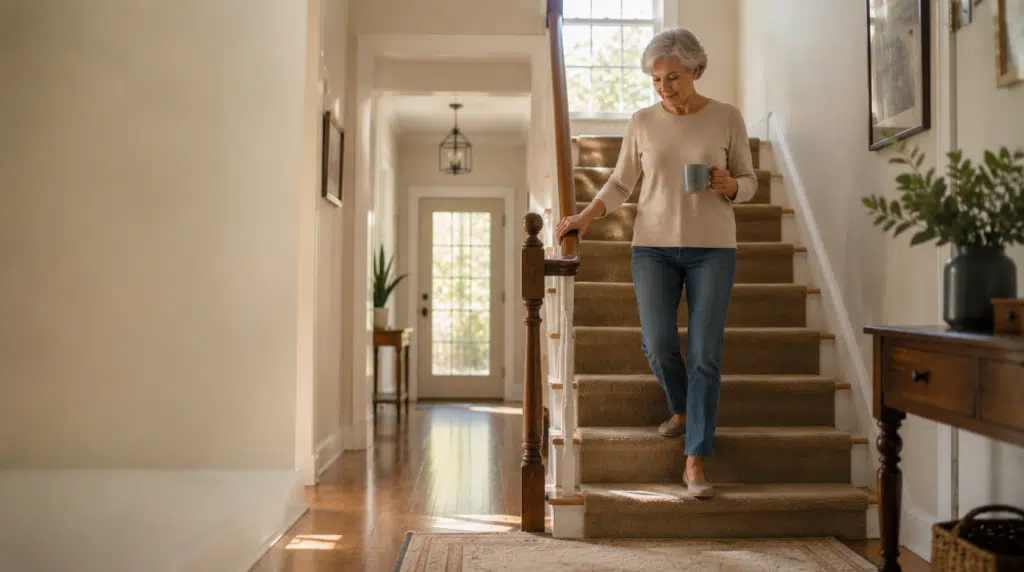
A woman in her early seventies walks down a carpeted staircase at home in morning light, holding a coffee mug and resting one hand on the railing.

Your mother caught her toe on the edge of the hall rug. She got herself up, said she was fine, and went back to what she was doing. Three weeks later she is still moving carefully, still sore across her lower back, and still telling you it was nothing.

September 22 is Falls Prevention Awareness Day, and it lands on the first day of autumn for a reason. Below you will find what a fall can do to the spine and the hip, the injury that most often gets waved off, what actually lowers the risk, and when to have someone looked at.

Reviewed by: Oren G. Blam, MD, a board-certified, fellowship-trained orthopedic spine surgeon at OACM. He sees patients at our Catonsville, Columbia, and Eldersburg clinics.

Watch: Dr. Oren Blam Talks Back Pain and Treatment

Falls are common, and that is exactly the problem

The numbers are larger than most families expect. The CDC reports that more than 14 million older adults, or 1 in 4, report falling every year, and that falls are the leading cause of injury for adults 65 and older. Roughly 37% of those who fall need medical treatment.

Because falls are so common, they get normalized. A fall becomes a story told at dinner rather than a reason to be seen. That is the gap this awareness day is aimed at.

The injury that gets missed

Hip fractures get attention because they are obvious and they land people in a hospital. The spine injury that follows a fall is quieter.

A vertebral compression fracture happens when a weakened vertebra cracks and loses height under pressure. AAOS describes these as occurring about 1.5 million times a year in the United States, nearly twice as often as the hip and wrist fractures caused by osteoporosis. The pain sits near the fracture, gets worse with movement and position changes, eases with rest, and can flare with a cough or a sneeze.

Read that description again and notice how easily it passes for a pulled muscle. That is why weeks go by.

Most compression fractures settle within about three months with rest, pain management, and sometimes a brace. When pain stays severe, AAOS notes that kyphoplasty uses a balloon to restore height inside the fractured vertebra before cement stabilizes it. OACM performs kyphoplasty in house.

Listen: Kyphoplasty: Small Procedure, Big Relief for Back Pain, Dr. Oren Blam on A Bone to Fix.

About Lynn Hendrickson, PA-C

Lynn Hendrickson, PA-C works with Dr. Blam on spine, neck, and back care. She earned a Master of Science in Physician Assistant Studies at Shenandoah University after earlier careers in speech-language pathology and elementary education. Her profile notes that her interest in orthopedics is personal, “shaped by her experiences as an athlete and inspired by her father, who continued running in the Colorado Rocky Mountains well into his 90s.”

That detail is worth sitting with on a page about falls. Staying on your feet into your nineties is not luck.

What actually lowers the risk

The good news in the research is that this is one of the more changeable risks in older adulthood.

Exercise, and specifically balance work. The US Preventive Services Task Force recommends exercise interventions for adults 65 and older who are at increased risk of falls, and grades that recommendation a B, meaning it found a moderate net benefit. NCOA makes the same point in plainer terms: anyone of any age or ability can get stronger and improve their balance.

A medication review. Some prescriptions, and some combinations, affect balance and blood pressure in ways that raise fall risk. NCOA lists this among its core prevention steps. It is a conversation worth having at the next appointment rather than assuming.

The house itself. Loose rugs, a dark stairway, a bathroom without a grab bar, a cord across a walking path. None of these feel like hazards until they are.

Vision and footwear. An out-of-date prescription and a worn pair of slippers do more damage than either one sounds like it should.

NCOA also offers a Falls Free CheckUp, a short self-assessment that takes about two minutes and is a reasonable place for a family to start.

When to have someone seen

Call and get an appointment if any of these follow a fall:

  • Back pain that has not eased after a week or two, especially with a history of osteoporosis
  • Pain that spikes with coughing, sneezing, or standing up
  • A visible change in posture, or a sense that they have gotten shorter
  • Any hip or groin pain, or difficulty putting weight through a leg
  • Numbness, tingling, or weakness in a leg

For an obvious emergency such as a head injury, a deformity, or an inability to bear weight at all, go to the emergency room. For everything else, an orthopedic visit with imaging on site gets you to a specialist directly.

Schedule at our Columbia, Catonsville, or Eldersburg clinic

If someone in your family had a fall this summer and has been quietly working around it since, September is a good month to stop working around it. Our spine and pain management team sees patients at Catonsville, Columbia, and Eldersburg, and OACM has physical therapy at eight Central Maryland locations for the strength and balance work that follows.

Call (410) 644-1880 or schedule online.

Frequently asked questions

My parent fell but says nothing hurts. Do they still need to be seen?
If they are moving normally and pain-free after a few days, watchful waiting is reasonable. If soreness lingers past a week or two, or if they have osteoporosis or a prior fracture, get it looked at. Compression fractures are easy to mistake for a strained muscle.
Are falls just part of getting older?
No. NCOA is direct about this, and so is the research. Falls are largely preventable, and strength and balance improve at any age.
What kind of exercise helps most?
Programs that train balance and lower-body strength together have the strongest evidence behind them. The USPSTF recommendation is based on exercise interventions of this kind. A physical therapist can build one around what a person can actually do today.
What is kyphoplasty, in plain terms?
It is a minimally invasive procedure for a painful vertebral compression fracture. A balloon makes space inside the collapsed bone, and cement holds the repair. AAOS describes it here. OACM performs it in house.

Disclaimer

The information in this article is for educational purposes only and is not a substitute for professional medical advice, diagnosis, or treatment. Always speak with a qualified orthopedic provider about your specific symptoms and medical history. To schedule an appointment with Orthopaedic Associates of Central Maryland, call (410) 644-1880 or visit mdbonedocs.com.

Filed Under: Common Fall Injuries, Neck Pain, Osteoporosis, Spine Tagged With: balance, Central Maryland orthopedics, compression fracture, fall prevention, falls, kyphoplasty, OACM, older adults, osteoporosis, spine health

Primary Sidebar

Recent Posts

  • A Fall Is Not Just a Fall: What Central Maryland Adults Should Know Before September 22
  • What Happens at a Pain Management Visit? A Central Maryland Guide
  • Joint Pain in Active Kids: When It’s More Than a Sports Injury
  • When Should You See a Sports Medicine Doctor? A Guide for Central Maryland Athletes
  • Is It Time to Consider Shoulder Replacement? What to Know Before You Decide
September 2026
M T W T F S S
 123456
78910111213
14151617181920
21222324252627
282930  
« Aug    

Categories

Tags

Back Pain best orthopedic doctor near me Central Maryland orthopedics chronic pain Foot and ankle specialist near me Foot Care foot pain hip hip pain hip replacement joint pain Joint Replacement knee pain Knee Pain Treatment Baltimore MD Knee pain treatment near me Knee Replacement low back pain treatment near me Neck Pain OACM Orthopaedic Associates of Central Maryland Orthopaedic Surgeon orthopedic care near me orthopedic clinic near me orthopedic doctor Baltimore MD orthopedic doctor Catonsville MD orthopedic doctor Central MD orthopedic doctor Columbia MD Orthopedic Doctor near me orthopedic doctors orthopedics orthopedic surgeon orthopedic surgeon near me orthopedic surgeons Baltimore Orthopedist Physical Medicine physical therapy Physical therapy near me Plantar Fasciitis treatment near me Podiatrist shoulder pain Shoulder Replacement Sports injuries sports injury Baltimore sports injury treatment near me sports medicine doctor near me

Footer

Patient Resources

Patient Education

Empower yourself with essential knowledge through our comprehensive patient education resources. Explore a wealth of information curated to enhance your understanding of orthopedic conditions, treatments, and wellness strategies.

Webinars
Podcasts
Patient FAQs
Patient Education Videos

Self-Assessment Tools

Take control of your health journey with our interactive self-assessment tools. Discover personalized insights for better orthopedic wellness.

Pain Assessment

Bone Health Assessment

FOLLOW US

Contact Us

(410) 644-1880

(855) 4MD-BONE

Physical Therapy:
(443) 478-4449

Who We Are

Services

Physical Therapy

Locations

OACM After Hours

Providers

OACM News

Careers

Get In Touch

Schedule an Appointment

Patient Portal

Contact Us

Copyright © | The Centers for Advanced Orthopaedics Orthopaedic Associates of Central Maryland Division | All Rights Reserved.

Privacy Policy Sitemap Accessibility Statement Non-Discrimination Policy

The Centers for Advanced Orthopaedics Orthopaedic Associates of Central Maryland Division is your premier center for comprehensive physical therapy and orthopedic services for conditions affecting the back and neck, foot and ankle, hand and wrist, hip and knee, and shoulder and elbow. We are also proud to offer a Bone Health Program, nonoperative treatments, after-hours care, and on-site imaging at our 12 locations across Central Maryland.

[su_labor_day_popup]