


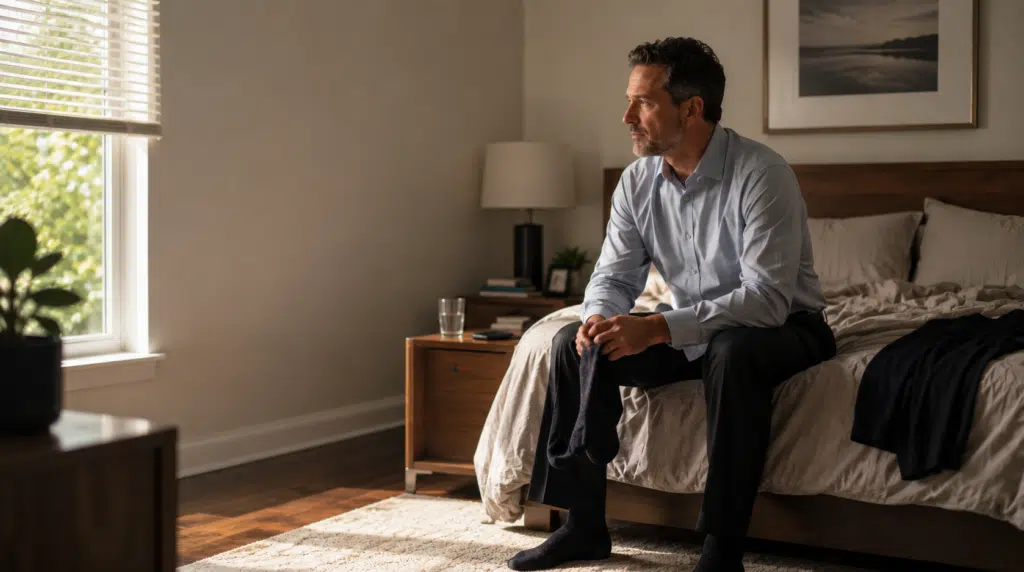
Your back has been at this for four months. Some mornings you can walk it off by the time the coffee is ready. Other mornings you sit on the edge of the bed and do the math on whether you can get through the workday. You have tried heat, ibuprofen, a new mattress, and the stretches a friend sent you. Nothing has stuck, and nobody has told you what comes next.
This post walks through what a pain management visit at Orthopaedic Associates of Central Maryland actually involves. You will learn what happens in the first appointment, why your doctor may order a nerve test before anything else, what injections can and cannot do, and the point at which a spine surgeon joins the conversation.
Featured provider: Michael DeMarco, DO, a board-certified physiatrist at OACM with more than 15 years in Physical Medicine and Rehabilitation, Pain Medicine, and Electrodiagnostic Medicine. He sees patients at our Catonsville, Columbia, and Eldersburg clinics. Credentials are taken directly from his mdbonedocs.com profile.
Watch: Dr. Michael DeMarco Discusses Spine Pain and Treatment
September is Pain Awareness Month, and the awareness part matters
Most people who live with back or neck pain wait longer than they should, not because they are stubborn but because nobody has explained what the next step even is. Surgery feels like the only thing on the other side of “keep resting,” so they keep resting.
There is a wide stretch of care between those two points, and it has a name. Pain management, or physical medicine and rehabilitation, is a specialty built around finding the source of the pain and treating it without an operating room whenever that is possible. At OACM, that is Dr. DeMarco’s practice, along with Emily Holloway, CRNP, who works alongside him.
Low back pain is close to universal. Almost every adult will have it at some point, according to the American Academy of Orthopaedic Surgeons. What is not universal is the reason behind it, and that is the part a first visit is designed to sort out.
The first appointment is mostly conversation
Patients often expect to be sent straight for a scan. Usually the appointment starts with a much longer conversation than they were braced for.
Where does the pain sit, and where does it travel? Is it worse first thing in the morning or by the end of the day? Does leaning forward on a shopping cart make walking easier? That last question is not small talk. People with lumbar spinal stenosis often feel better when they lean forward or sit down, and standing up straight or walking usually makes it worse. A single answer like that can move a diagnosis a long way before any imaging happens.
The physical exam follows. Reflexes, strength, sensation, how you move and where the movement stops. OACM has imaging on site, so if an X-ray is useful that day, you are not sent across town for it.
You should leave the first visit knowing three things: what your doctor thinks is causing the pain, what the plan is, and what would have to change for the plan to change.
Why a nerve test may come before anything else
If your pain comes with numbness, tingling, or weakness in an arm or a leg, your doctor may order an EMG and nerve conduction study. Dr. DeMarco is board-certified in electrodiagnostic medicine, which is the subspecialty built around exactly this test, and OACM performs EMG and nerve conduction studies in house.
Here is what the test does. An electromyogram measures the electrical activity in your muscles, and the nerve conduction portion measures the speed and strength of signals traveling between two points. Together they can tell whether a nerve is being compressed, where along its path the trouble starts, and whether the problem is the nerve, the muscle, or the connection between them.
That matters because an MRI shows structure, not function. Plenty of people over 50 have imaging that looks worn without any symptoms at all. By age 50, up to 95% of people have some degenerative change in the spine. A nerve study helps separate the finding that explains your symptoms from the finding that just happens to be there.
Where physical therapy fits, and why it is not a consolation prize
Physical therapy gets treated as the thing you do while waiting for the real treatment. It is closer to the opposite. For a large share of back and neck problems, it is the treatment.
AAOS describes therapy for low back pain as a mix of passive care such as heat, ice, and massage alongside active work like stretching, strengthening, and cardiovascular exercise. Cervical radiculopathy, the pinched nerve in the neck that sends pain down an arm, responds to a similar approach. AAOS notes that most patients with cervical radiculopathy improve over time, and that initial treatment should be nonsurgical.
OACM has physical therapy at eight locations: Catonsville, Clarksville, Columbia, Eldersburg, Ellicott City, Fulton, Laurel, and Westminster. Being able to hand a patient off to a therapist who can read the same chart is a practical advantage, not a small one.
Watch: Spine Pain Recovery Isn’t Random, It Follows This Pattern
What injections actually do
Injections carry a reputation problem. Some patients think they are a step toward surgery. Others think they are a way of avoiding a real answer.
They are neither. A spinal injection is often two things at once. AAOS explains that an epidural steroid injection delivers anesthetic or anti-inflammatory medication near an irritated nerve, and that a single anesthetic injection at an isolated nerve can also identify whether that nerve is the source of the pain. Facet joint injections work the same way for the small joints between the vertebrae. Relief after the injection tells your doctor something a scan cannot.
OACM’s interventional spine program includes epidural steroid injections, facet joint injections, nerve blocks, trigger point injections, radiofrequency ablation, and spinal cord stimulation for certain chronic nerve pain. Which of those is on the table depends entirely on what the workup found.
Watch: Dr. Michael DeMarco Talks Pain Control: Implantable Nerve Stimulators
An injection may quiet the pain enough that therapy finally works. That is often the whole point of it.
When a spine surgeon joins the conversation
Some patients do reach a point where surgery is the right discussion, and at OACM that conversation happens in the same practice rather than at the end of a referral chain. Oren G. Blam, MD, a board-certified, fellowship-trained spine surgeon, sees patients at Catonsville, Columbia, and Eldersburg, with Lynn Hendrickson, PA-C on his team.
The signs that move a case that direction are usually specific: leg or arm weakness that is getting worse, pain that has not responded to a real course of nonsurgical care, or a structural problem that therapy cannot reach. AAOS lists leg weakness and loss of bladder or bowel control as symptoms that need attention right away rather than a wait-and-see plan.
About Dr. DeMarco
Dr. DeMarco earned his medical degree at the School of Osteopathic Medicine at the University of Medicine and Dentistry of New Jersey and completed his internship and residency at Walter Reed Army Medical Center. He chairs the Maintenance of Certification Committee of the American Board of Electrodiagnostic Medicine and is a member of the American Association of Neuromuscular & Electrodiagnostic Medicine and the American Society of Interventional Pain Physicians.
His published specialty list covers neck and lower back pain, generalized joint pain, numbness, tingling, and weakness in the extremities, and “comprehensive care for patients with chronic pain (minimizing the use of opioid medications).” That last line is the through-line of the practice.
Schedule with our pain management team
If your neck or back pain has outlasted a few weeks of rest and over-the-counter care, that is a reasonable time to have it looked at. Dr. DeMarco and Emily Holloway, CRNP see patients at our Catonsville, Columbia, and Eldersburg clinics.
Call (410) 644-1880 or schedule online.
Frequently asked questions
Disclaimer
The information in this article is for educational purposes only and is not a substitute for professional medical advice, diagnosis, or treatment. Always speak with a qualified orthopedic provider about your specific symptoms and medical history. To schedule an appointment with Orthopaedic Associates of Central Maryland, call (410) 644-1880 or visit mdbonedocs.com.
 Webinars
 Podcasts
 Patient FAQs
 Patient Education Videos
 Pain Assessment
 Bone Health Assessment
