


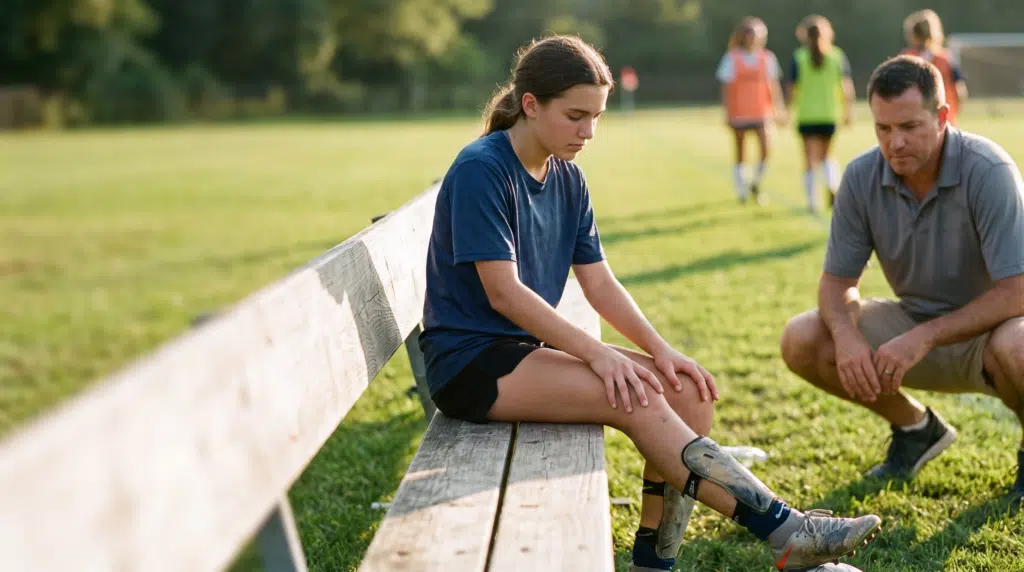
You planted your foot during Saturday’s rec-league soccer game, felt a pop in your knee, and limped to the sideline. Two days later, you’re still icing it and wondering: is this something that heals on its own, or something a doctor should look at?
If you’ve ever asked that question, this guide is for you. Below, you’ll learn what sports medicine doctors actually treat, which injuries tend to show up this time of year, and the warning signs that mean it’s time to stop guessing and get checked.
Featured provider: Michael J. Wallace, MD, a board-certified, fellowship-trained orthopedic surgeon specializing in sports medicine at OACM, and team physician for Atholton High School in Columbia since 2009.
What does a sports medicine doctor treat?
Sports medicine is the branch of orthopedic care focused on injuries and conditions that come from physical activity, whether that’s varsity football, weekend pickleball, or chasing a toddler around the yard. You do not need to be an “athlete” to see a sports medicine doctor.
At OACM, our seven-physician sports medicine team (Scott M. Adams, MD; Nicholas P. Grosso, MD; Richard D. Kinnard Sr., MD; M. Brian Polsky, MD; Scott L. Silverstein, MD; Michael J. Wallace, MD; and Ralph T. Zade, MD, all board-certified orthopedic surgeons) cares for problems like sprains and strains, ligament injuries such as ACL and MCL tears, meniscus tears, rotator cuff injuries, tendonitis and overuse injuries, stress fractures, dislocations, and cartilage damage. Many of these can be treated without surgery. When surgery is the right option, it’s often done with minimally invasive arthroscopic techniques.
This is a team that has walked plenty of sidelines. Between them, our sports medicine physicians have cared for athletes with the U.S. Soccer Federation and the Women’s World Cup team (Dr. Adams), the Baltimore Ravens, Washington Wizards, and Washington Capitals (Dr. Zade), the Philadelphia Eagles and Flyers (Dr. Polsky), the Philadelphia Phillies (Dr. Kinnard), and high schools across Howard County and Central Maryland.
Late summer is prime time for sports injuries
August in Central Maryland means preseason. High school fall sports are ramping up, adult leagues are back from summer break, and many of us jump from a relaxed summer straight into hard training. That sudden increase in load is one of the most common setups for sports injuries, because muscles, tendons, and joints haven’t been prepared for it.
The injuries we tend to see most this time of year: ankle sprains from cutting and pivoting sports, hamstring and groin strains from sprinting without a ramp-up, shoulder and elbow overuse injuries in throwers, shin splints and stress reactions in runners, and knee injuries from field sports.
Home care vs. doctor visit: how to tell the difference
For many mild injuries, the first 24 to 48 hours of self-care follow a familiar pattern: relative rest, ice, compression, and elevation, plus avoiding the activity that caused the pain.
But some signs suggest the injury needs professional evaluation. Come in promptly if:
- You heard or felt a “pop” at the moment of injury
- You can’t put weight on the limb or use the joint normally
- There’s significant swelling, especially within the first hours
- The joint feels unstable, like it might give way
- There’s visible deformity
- You have numbness or tingling
- Pain isn’t improving after several days of rest
Waiting too long on the wrong injury can make things harder. A ligament tear that goes unaddressed, for example, may lead to repeated instability episodes and further damage to the meniscus and cartilage over time.
What treatment actually looks like
A first visit typically includes a physical exam, a conversation about how the injury happened, and imaging if needed. OACM offers on-site imaging, so you don’t have to make a separate trip.
From there, treatment is matched to the injury and to your goals: activity modification and a structured return-to-play plan, physical therapy at one of our eight PT locations across Central Maryland, bracing or casting, injections when appropriate, and surgery when the injury requires it. Many patients with sports injuries recover fully without ever needing an operation.
What recovery looks like
Recovery is rarely a straight line, and timelines vary widely by injury and by person. A mild ankle sprain may settle in a few weeks; ACL reconstruction recovery is commonly measured in months. What matters most is a plan: clear milestones, progressive loading, and a return-to-sport decision based on function rather than the calendar. Rushing back before the injury is ready raises the risk of re-injury. In one study of young athletes, returning to sport before nine months after ACL reconstruction was associated with roughly seven times the rate of new injury compared with those who waited.
Our physicians and physical therapists work from the same playbook, so the plan your doctor sets is the plan your PT executes.
Featured provider
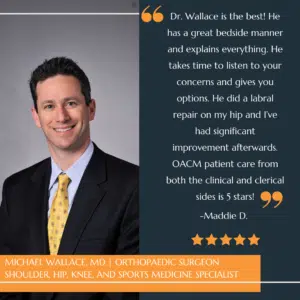
Michael J. Wallace, MD is a board-certified, fellowship-trained orthopedic surgeon at OACM specializing in sports medicine. He earned his medical degree from the University of Southern California, completed his orthopedic surgery residency at Albany Medical Center, and performed his sports medicine fellowship at MedStar Union Memorial Hospital in Baltimore, where he worked with professional teams including the Baltimore Ravens. He has served as team physician for Atholton High School in Columbia since 2009 and has worked with Loyola University, Johns Hopkins University, Morgan State University, and Stevenson University. His clinical focus includes arthroscopic surgery of the shoulder, hip, and knee; rotator cuff and labral tears; ACL/PCL and meniscus tears; tendon tears; fracture care; and partial and full knee replacement. He sees patients at OACM’s Catonsville, Columbia, and Eldersburg clinics.
One patient’s path back to the field
This example is illustrative and is not based on any individual patient.
Consider a 16-year-old midfielder who rolls her ankle in a preseason scrimmage. The swelling looks dramatic, and her parents fear a fracture. An exam and X-ray at our Columbia clinic point instead to a moderate ankle sprain. She’s fitted with a brace, starts physical therapy that week, and follows a progressive return-to-play plan. By mid-season she’s back on the field, with better ankle strength than before the injury.
Want to understand what’s actually injured?
Bones, joints, cartilage, muscles, ligaments, and tendons each behave differently when they’re hurt, and figuring out which one is involved is a large part of why the diagnosis matters. Our guide to the anatomy of a sports injury walks through all six in plain language.
Schedule with our sports medicine team
If a sports injury is slowing you down, our team is ready to help, often with same-day appointments. Call (410) 644-1880 or (855) 4MD-BONE to schedule with Dr. Wallace or another OACM sports medicine physician at our Catonsville, Columbia, Eldersburg, or Fulton clinic. Online scheduling is available at s.odoro.com/cfaortho. For physical therapy, call (443) 478-4449.
Frequently asked questions
Disclaimer
The information in this article is for educational purposes only and is not a substitute for professional medical advice, diagnosis, or treatment. Always speak with a qualified orthopedic provider about your specific symptoms and medical history. To schedule an appointment with Orthopaedic Associates of Central Maryland, call (410) 644-1880 or visit mdbonedocs.com.
 Webinars
 Podcasts
 Patient FAQs
 Patient Education Videos
 Pain Assessment
 Bone Health Assessment
