



You wake up, swing your legs over the side of the bed, and your low back catches before your feet even hit the floor. You tell yourself you slept wrong. Then a week goes by. Then six. The ache has started to follow you down the stairs, into the car, and out into the yard.
If that sounds like the conversation you keep having with yourself, you’re not alone. About four out of five U.S. adults will deal with low back pain at some point in their lives (NIH / NIAMS). In this article you’ll learn what’s usually going on under the surface, which symptoms suggest you should see a spine provider sooner rather than later, and the treatment options — from the simplest to the most advanced — that tend to help the most patients get back to the things they love.
Featured provider: Michael DeMarco, DO, a board-certified physiatrist at OACM specializing in Physical Medicine & Rehabilitation, Pain Medicine, and Electrodiagnostic Medicine — the non-surgical, interventional side of spine and joint care.
What’s actually happening in your low back
Your lumbar spine is a five-bone column built to carry roughly two-thirds of your body weight. Between each pair of vertebrae sits a disc that cushions impact, and on the back of each disc is a small joint that lets you bend and twist. Threading down through the middle is the spinal cord and the nerve roots that branch off to your hips, legs, and feet.
When something irritates that whole system — a disc that’s bulging, a joint that’s inflamed, a muscle that’s been overworked, or a narrow channel pressing on a nerve — your back lets you know. Most low back pain is what providers call “non-specific,” meaning there isn’t one single structure to blame, and the pain usually improves within a few weeks of self-care (NIH / NIAMS).
But sometimes the pain doesn’t improve. Sometimes it travels into one leg as a sharp, burning, or electric line — that’s sciatica (NINDS), which is irritation of a nerve root, most often from a disc problem or from a narrowing called lumbar spinal stenosis (AAOS OrthoInfo). And sometimes the spine itself has lost height, often from a small fracture in a vertebra you didn’t realize you had (Mayo Clinic).
Knowing which of these is yours is the job of an orthopedic spine evaluation.
Why Central Maryland patients feel it in June
Low back pain doesn’t have a “season.” Your activity does. After a quieter winter and a slow spring, June is when many of our patients in Catonsville, Columbia, Eldersburg, and Fulton get back to the things that quietly tax the lumbar spine — yard work, gardening, golf, pickleball, lifting kids and grandkids, long car trips, summer travel. Bodies that were managing in March suddenly have something to say.
Common June triggers we see at OACM:
- A sharp jump in activity. A three-hour day in the garden after a winter of sitting can light up muscles and joints that aren’t ready for it.
- Repetitive bending and twisting. Pulling weeds, edging beds, and loading the car for the beach all combine flexion and rotation — the two movements lumbar discs like the least.
- Poor workplace posture stacking up. If you spent the winter hunched over a laptop, the muscles that stabilize your spine may not be ready for a sudden return to weekend yard work.
- Old injuries reactivating. A back that’s “been fine for years” can flare with the first heavy weekend.
When to call us — and when to skip the wait
Most non-specific low back pain improves with two to six weeks of conservative care (AHRQ / ACP 2017 Clinical Practice Guideline). Call an OACM provider sooner if:
- The pain travels down one leg below the knee, especially with numbness, tingling, or weakness
- You feel weakness in a foot, or your foot is “slapping” when you walk
- You have a known history of cancer, IV drug use, or long-term steroid use and have new back pain
- You have an unexplained fever with the back pain
- The pain is worse at night or wakes you from sleep
- Conservative care hasn’t helped after about six weeks
And please go to an emergency department immediately — do not wait — if you have any of the following, which can signal a rare but serious condition called cauda equina syndrome: loss of bladder or bowel control, numbness in the groin or inner thighs (the “saddle” area), or sudden severe weakness in both legs (NIH / NIAMS).
Treatment, from least to most invasive
The principle our spine team works by is simple: start with the least invasive option that’s likely to help, escalate only as needed, and image only when the answer will change what we do next.
Activity, education, and movement. For non-specific low back pain, current evidence-based guidelines recommend starting with movement — gentle walking, daily activity, heat, and education — rather than bed rest (AHRQ / ACP).
Physical therapy. A focused course with an OACM physical therapist at our Catonsville, Clarksville, Columbia, Eldersburg, Ellicott City, Fulton, Laurel, or Westminster PT location can address the muscle imbalances, mobility limits, and movement patterns that keep flaring you up.
Medications, used carefully. Over-the-counter anti-inflammatories may help short-term. Opioids are not a first-line option for chronic low back pain (AHRQ / ACP).
Targeted injections. When pain is coming from a specific nerve root, facet joint, or sacroiliac joint, image-guided injections may quiet the pain enough to make therapy effective.
Minimally invasive in-office procedures. For patients whose pain is driven by lumbar spinal stenosis — a narrowing of the spinal canal that compresses nerves — OACM performs the mild® procedure in-house. mild® stands for minimally invasive lumbar decompression and is designed to remove a small piece of bone and excess ligament tissue through a tiny incision, making more room for the compressed nerves. For patients whose pain is driven by a vertebral compression fracture, we also perform kyphoplasty in-house, a minimally invasive procedure designed to stabilize the fractured vertebra and help restore the spine’s natural shape (Mayo Clinic).
Outpatient spine procedures. For appropriate candidates, our spine experts also perform endoscopic spinal decompression and interlaminar decompression and stabilization on an outpatient basis — both designed to relieve pressure on the spinal cord and nerves through smaller incisions than traditional open surgery.
The right step for you depends on what’s actually causing the pain, not just where it hurts.
Featured provider
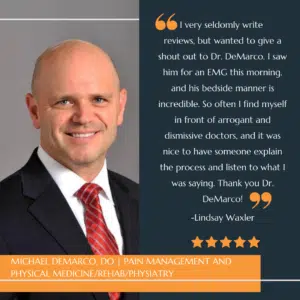
Michael DeMarco, DO is a board-certified physiatrist at OACM with more than 15 years of experience in Physical Medicine & Rehabilitation, Pain Medicine, and Electrodiagnostic Medicine. He earned his medical degree at the School of Osteopathic Medicine at the University of Medicine and Dentistry of New Jersey and completed his internship and residency at Walter Reed Army Medical Center. His practice focuses on diagnosing and treating neck and lower back pain, generalized joint pain, numbness and tingling in the extremities, and comprehensive care for patients with chronic pain — with a strong emphasis on minimizing opioid use. He sees patients at OACM’s Catonsville, Columbia, and Eldersburg clinics, and his team includes Emily Holloway, CRNP.
Hear it from Dr. DeMarco
Dr. DeMarco walks through lumbar spinal stenosis — the symptoms most patients miss for too long, how it’s diagnosed, and the treatment options including the in-office mild® procedure.
Schedule with our spine team
If your low back pain is more than a week or two old, traveling into a leg, or interrupting your sleep, call (410) 644-1880 or (855) 4MD-BONE to schedule with Dr. DeMarco or another OACM spine provider at our Catonsville, Columbia, or Eldersburg clinic. Online scheduling is available. If you’d rather start with physical therapy, our PT team can be reached at (443) 478-4449.
Frequently asked questions
The information in this article is for educational purposes only and is not a substitute for professional medical advice, diagnosis, or treatment. Always speak with a qualified orthopedic provider about your specific symptoms and medical history. To schedule an appointment with Orthopaedic Associates of Central Maryland, call (410) 644-1880 or visit mdbonedocs.com.
 Webinars
 Podcasts
 Patient FAQs
 Patient Education Videos
 Pain Assessment
 Bone Health Assessment
