



You reach up to grab a glass from the top shelf, and a sharp ache shoots through your shoulder. That night, you roll onto that side in bed and the pain wakes you up. Lifting your arm to wash your hair suddenly feels like a chore. If any of this sounds familiar, your rotator cuff may be trying to tell you something.
In this article, you’ll learn what a rotator cuff tear actually is, the symptoms worth paying attention to, and the range of treatment options available, from rest and physical therapy to surgery, so you can have an informed conversation with an orthopedic provider.
Featured provider: Scott M. Adams, MD, a board-certified, fellowship-trained orthopedic surgeon and sports medicine specialist at OACM whose listed specialties include rotator cuff tears and shoulder labrum injuries. Credentials and the quote below are taken directly from his mdbonedocs.com profile.
What is the rotator cuff?
Your rotator cuff is a group of four muscles and their tendons that surround the shoulder joint. Together, they hold the ball of your upper arm bone snugly in the shoulder socket and let you raise and rotate your arm. (AAOS) When one or more of those tendons is irritated, partially frayed, or fully torn, that smooth teamwork breaks down, and that’s when the trouble starts.
Tears generally fall into two camps. A degenerative tear develops slowly over time as tendons wear down with age and repetitive use. An acute tear happens suddenly, often from a fall onto an outstretched arm or lifting something too heavy. (AAOS)
Symptoms: what a rotator cuff tear can feel like
Rotator cuff problems don’t always announce themselves with dramatic pain. Many patients describe a dull ache deep in the shoulder that builds gradually. Common signs include a nagging pain that worsens at night, especially when you lie on the affected side; difficulty or weakness when lifting or rotating your arm; a crackling sensation with certain movements; and trouble with everyday motions like reaching behind your back or fastening a seatbelt.
Not every tear causes pain, and some people have a tear for years without realizing it. (AAOS) That’s exactly why symptoms that linger beyond a couple of weeks are worth having checked.
What causes rotator cuff tears?
Two main paths lead to a torn rotator cuff. The first is wear and tear: tendons naturally weaken as we age, and decades of overhead motion add up, which is why tears become more common after age 40. (AAOS) People whose jobs or hobbies involve repeated overhead movement, like painters, carpenters, swimmers, and tennis and baseball players, tend to be at higher risk.
The second path is injury. A single forceful event, such as catching yourself during a fall or hoisting a heavy box overhead, can tear a tendon all at once. Sometimes an acute injury lands on top of a tendon that was already worn down, turning a minor strain into a larger tear.
Treatment options: from conservative care to surgery
Here’s the encouraging part: many rotator cuff tears improve without surgery. Treatment is highly individual and depends on the size of the tear, your activity level, and how much the shoulder is limiting your daily life.
Non-surgical care is often the starting point, and it works for most people: in about 80% to 85% of patients, nonsurgical treatment relieves pain and improves function in the shoulder. (AAOS) It may include rest and activity modification, anti-inflammatory medication, a focused physical therapy program to strengthen the surrounding muscles, and sometimes a corticosteroid injection to calm inflammation. Many patients regain meaningful function through physical therapy alone. (AAOS)
When non-surgical care doesn’t relieve symptoms, or when a tear is large or the result of an acute injury in an active person, surgery may be recommended. Modern rotator cuff repair is frequently done arthroscopically, using small incisions and a camera to reattach the tendon to the bone. (AAOS) Recovery takes time and commitment to rehabilitation, but many patients experience significant improvement in pain and strength. There is no single right treatment for everyone. A board-certified orthopedic shoulder specialist can examine your shoulder, review imaging, and help you find the option that fits.
When should you see a doctor?
Consider scheduling an evaluation if shoulder pain lasts more than a week or two, if you notice weakness or can’t lift your arm, if the pain regularly disrupts your sleep, or if the shoulder gave out suddenly after a fall or heavy lift. Catching a tear earlier can keep a small problem from becoming a bigger one.
From Dr. Adams
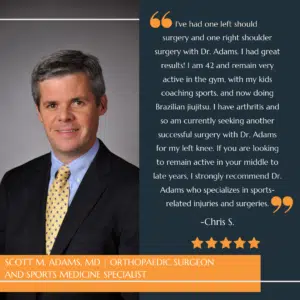
Dr. Adams brings a patient’s perspective to shoulder care. As a former athlete, his OACM profile notes that he “can honestly say, ‘I know how it feels,'” having had many of the injuries he now diagnoses and treats, which include rotator cuff tears and shoulder labrum injuries.
Watch: shoulder care from our specialists
Prefer to watch? Our shoulder team covers rotator cuff care in this short video.
WordPress note: paste the YouTube URL on its own line to embed the player inline. Confirm the clip before publishing; swap to another video from the July set if preferred.
Schedule with our shoulder team
If shoulder pain is getting in the way of your sleep, your sport, or your workday, our shoulder specialists are ready to help. Schedule an evaluation at our Columbia clinic, or any Central Maryland location in Catonsville, Eldersburg, or Fulton, by calling (410) 644-1880 or (855) 4MD-BONE, or book online.
Frequently asked questions
Disclaimer
The information in this article is for educational purposes only and is not a substitute for professional medical advice, diagnosis, or treatment. Always speak with a qualified orthopedic provider about your specific symptoms and medical history. To schedule an appointment with Orthopaedic Associates of Central Maryland, call (410) 644-1880 or visit mdbonedocs.com.
 Webinars
 Podcasts
 Patient FAQs
 Patient Education Videos
 Pain Assessment
 Bone Health Assessment
